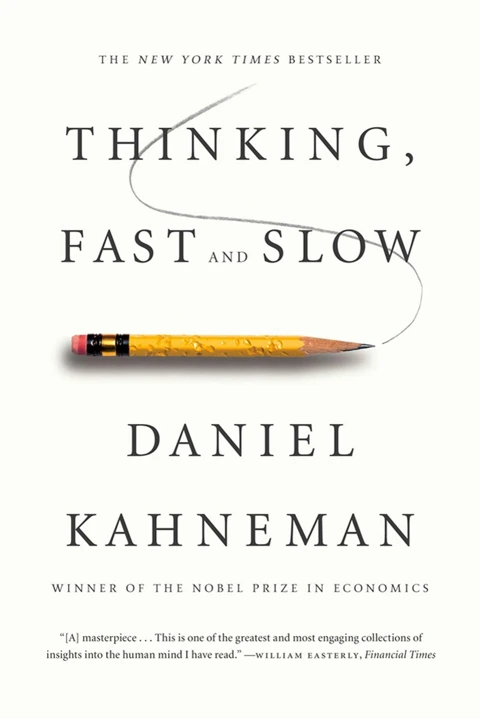
 Book cover · ISBN 9780374533557
Daniel Kahneman examines how people judge, predict, and choose. He describes fast, automatic thinking alongside slower, effortful reasoning. These are useful models of mental activity, not two neatly separated organs or personalities.
Confidence is not the same as accuracy
A coherent explanation can feel convincing even when the evidence is limited. The book explores anchoring, framing, and the tendency to neglect statistical information. Intuition works well in some settings but becomes unreliable when patterns are misleading or feedback is poor.
Evaluate the decision, not only the result
Luck can produce a good outcome from a weak choice. Kahneman’s work encourages attention to the information available at the time and to how comparisons shape preference. Slower thinking helps, but it is not automatically free of bias.
A question to carry away
What would change this judgment, and what relevant information is missing? The useful habit is to make reasoning more inspectable rather than assume that knowing a bias makes us immune to it.